Aromal Hollywood Cinemas Al Pacino, Classic Hollywood, Crime Drama, Francis Ford Coppola, Gordon Willis, James Caan, Mario Puzo, Marlon Brando, The Godfather, The Godfather 1972 0
THE GODFATHER (1972)
Director
Francis Ford Coppola
Cast
- Marlon Brando as Vito Corleone — The Godfather, head of the Corleone crime family
- Al Pacino as Michael Corleone — Vito’s youngest son, a war hero who wants nothing to do with the family business
- James Caan as Sonny Corleone — the hot-headed eldest son
- Robert Duvall as Tom Hagen — the family’s loyal consigliere and adopted son
- Diane Keaton as Kay Adams — Michael’s girlfriend who becomes drawn into the world she never understood
- Talia Shire as Connie Corleone — the Godfather’s only daughter
Crime, Drama
THE GODFATHER (1972)
“Francis Ford Coppola”
The Film That Made Me Understand Why People Call It the Greatest
I am going to be honest with you. For the longest time, I avoided The Godfather. Not because I had anything against it, but because when a film is called “the greatest movie ever made” by almost everyone who has ever watched it, there is a certain pressure that builds up. What if I watch it and feel nothing? What if I sit there for three hours and think, “yes, that was fine”? That would be embarrassing in a way. So I kept putting it off.
But there comes a point when you simply have no more excuses. I was sitting in my room today (02.03.2026), the kind of quiet evening where you do not want to do anything particularly productive but you also do not want to waste the time. In Netflix, saw The Godfather sitting there, and thought — alright, let me watch this.
Three hours later, I sat there in silence for a few minutes after the credits rolled. Not because I was confused or underwhelmed. But because I had just watched something that felt genuinely complete. Like a full meal when you were starving. The Godfather is not just a great film. It is a film that makes you understand what cinema is capable of at its highest level.
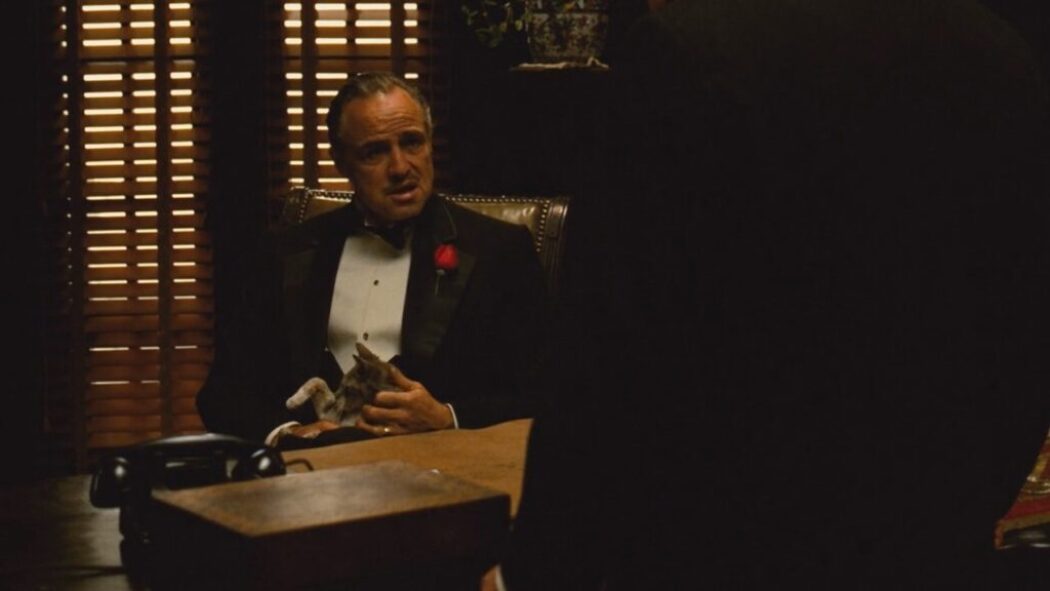
Vito Corleone in shadow during opening scene, cat in his lap, listening to a request
Synopsis
The Godfather tells the story of the Corleone family, one of the most powerful Mafia families in New York. Vito Corleone — a man of quiet authority and absolute power — rules his empire with patience and intelligence. When a rival gangster asks him to support a narcotics deal and Vito refuses, an assassination attempt leaves him critically wounded. His hot-headed son Sonny takes charge while his youngest son Michael — a decorated war veteran who has deliberately kept himself away from the family’s criminal world — is slowly, inevitably pulled into the life he tried to avoid. What follows is a story about power, loyalty, family, betrayal, and the heavy cost of the choices we make. By the end, Michael Corleone is not the man we met at the beginning and the film makes you feel every step of that transformation.
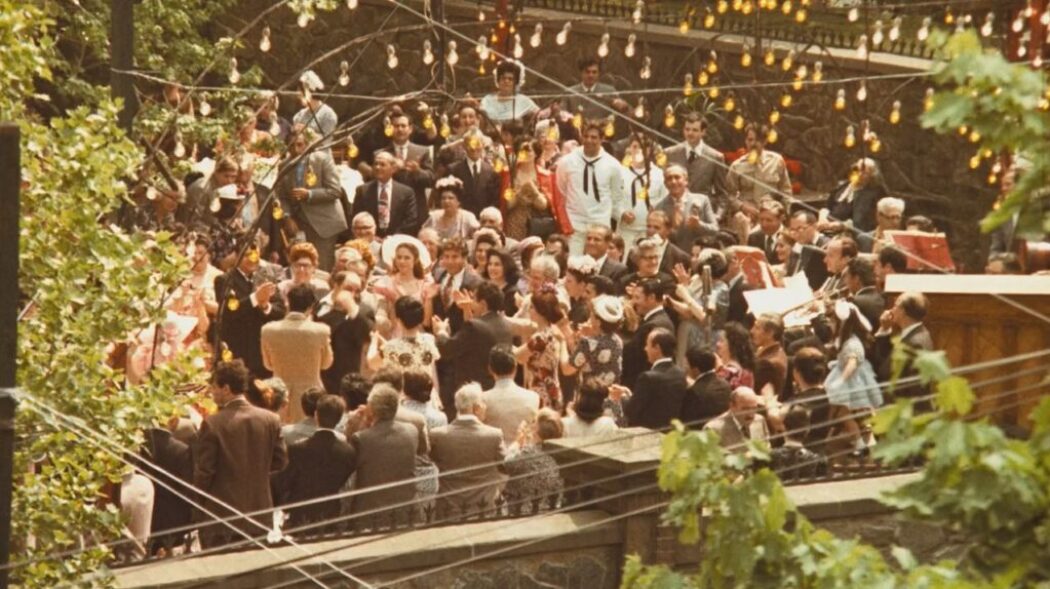
The Corleone wedding — two worlds in one frame
Review
Vito Corleone — Marlon Brando
I did not expect Marlon Brando to move me the way he did. I have seen clips of his performance online, the famous scenes, the lines everyone quotes. I thought I knew what to expect. But watching him in full context is a completely different experience. Brando plays Vito Corleone not as a villain but as a patriarch. A man who loves his family deeply and has built an empire with his own hands, operating by his own code of honour in a world without rules.
The scene that stayed with me the longest is when Vito is in the garden near the end of the film, playing with his young grandson, eating oranges, just being an old man enjoying a quiet afternoon. There is something profoundly human about it. This man who has ordered deaths and shaped criminal empires is at his most peaceful doing something completely ordinary. Brando communicates a lifetime of complexity without saying a single word in that moment. It is extraordinary acting.

Vito in the orange grove with his grandson, sunlit and peaceful
The raspy voice, the deliberate pauses, the way he moves and holds himself — everything Brando does in this film feels like it was thought about deeply. He won the Academy Award for this role and refused to accept it as a political statement. Whatever you think about that decision, the performance itself is undeniable.
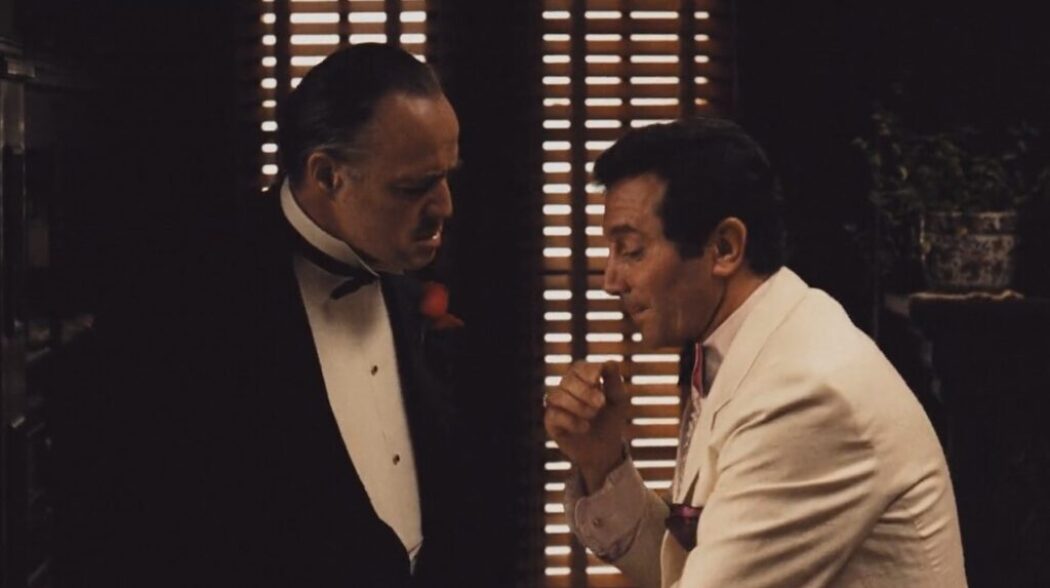
Vito Corleone in private counsel during the wedding — power and authority communicated through close framing
Michael Corleone — Al Pacino
If Brando gives the most iconic performance in the film, Al Pacino gives the most important one. The entire film belongs to Michael’s journey and Pacino carries it with a quiet intensity that keeps building throughout every scene.
When we first meet Michael, he is the good son. He sits at his sister’s wedding in his army uniform, he holds his girlfriend Kay’s hand, and he tells her clearly — “That’s my family, Kay. It’s not me.” He genuinely believes this. And so do we. What Pacino does brilliantly is make the transformation feel completely believable. Michael does not suddenly become a different person. He makes a series of choices, each one logical given his circumstances, and by the time you realise what he has become, you have been watching it happen so gradually that it does not feel like a shock. It feels inevitable.
The restaurant scene where Michael meets Sollozzo and Captain McCluskey is one of the greatest scenes in cinema history. Watch Pacino’s face before he pulls the trigger. The stillness. The decision being made in real time. I genuinely held my breath.
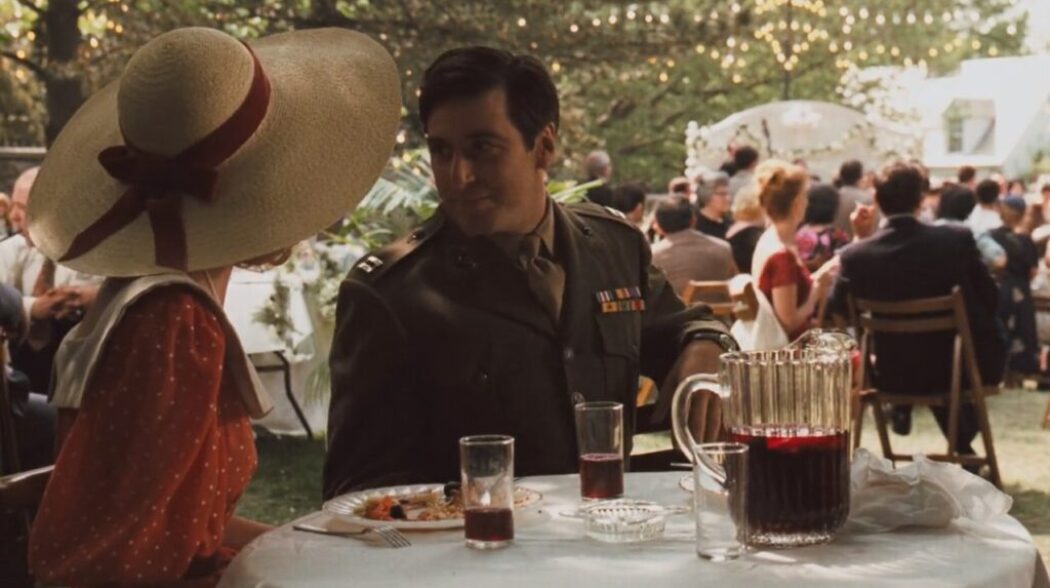
Michael in his army uniform sitting with Kay at the wedding

Louis Restaurant — Michael hemmed in, yet in control
Sonny Corleone — James Caan
Sonny is everything Michael is not — loud, impulsive, emotional, and dangerous because of it. James Caan plays him with so much energy that every scene he is in crackles with tension. You are always slightly worried about what Sonny is going to do next. And that worry is entirely justified.
His death at the tollbooth is one of the most brutal and shocking scenes in the film, and it hits hard because despite his flaws, Sonny is genuinely likeable. Caan made sure of that. The tragedy of Sonny is that his love for his family — the same quality that makes him human — is the thing that gets him killed.
The Transformation of Michael — The Real Story
What makes The Godfather more than just a crime film is this central question it keeps asking: how does a good man become this? And the answer Coppola and Mario Puzo give us through the screenplay is deeply uncomfortable because it is so understandable. Michael does not choose evil. He chooses family, and loyalty, and survival. Each individual decision makes sense. It is only when you step back and look at where he ends up that you feel the weight of what has been lost.
The final shot of the film — Kay watching the door close as Michael receives the loyalty of his men, the new Godfather — is one of the most devastating endings I have ever seen. She realises in that moment what she has married into. And we realise it with her.

Michael at the baptism — the transformation complete

Close-up of Michael’s face during the baptism, cold and expressionless
Cinematography
Gordon Willis shot this film and earned the nickname “The Prince of Darkness” for his work here. As a photographer myself, I find Willis’s approach to The Godfather absolutely fascinating. He made deliberate choices that went against every conventional rule of filmmaking at the time. The most striking of these is how he lit Marlon Brando in the opening scene. Vito Corleone sits in near total shadow during the wedding, his face barely visible, light catching only certain angles. Studio executives were horrified when they saw the rushes — they thought the film was underexposed and Willis had made a catastrophic error. But Coppola trusted him. And the result is one of the most iconic pieces of lighting in film history. The darkness around Vito communicates power, mystery, and danger without a single line of dialogue.

Vito Corleone in darkness during the opening scene conversation
Willis also used warm amber tones throughout the Corleone household scenes — golden, almost nostalgic light that makes the family feel close and intimate. Then in contrast, scenes outside the family’s world are cooler and harsher. It is a visual language that separates the warmth of family from the coldness of the world they inhabit.

Michael in exile — the vast Sicilian landscape communicating isolation and transition
From a compositional standpoint, Willis and Coppola use doorways and windows constantly as framing devices. Characters are often shot through doors, or partially obscured by architectural elements. It creates a sense of watching something private, something you are not quite supposed to see. As someone who thinks about composition carefully in my own photography, I found myself pausing the film multiple times just to study the frame.
The most photographically striking moment for me is the wide shot of Sonny\\\’s body at the tollbooth. The camera holds its distance, showing a man of enormous presence lying small against the vast empty space of the toll plaza. The bullet-riddled car beside him, the open sky above — it is a masterpiece of scale and perspective, using negative space to communicate the devastating cost of impulsiveness.

Sonny at the tollbooth — a man of enormous presence reduced
Behind the Scenes – A Few Things That Surprised Me
After watching the film I spent time reading about how it was made, and several things genuinely surprised me.
Marlon Brando was not the studio’s first choice for Vito Corleone. Paramount Pictures wanted a more conventional star and were deeply reluctant to cast him. Coppola fought hard for Brando and eventually won the argument partly by filming a private screen test of Brando transforming himself into the character in real time. When the executives watched the footage they reportedly did not even recognise who they were looking at. That screen test is the reason we have the performance we have.
The cat that Brando holds in the opening scene was not in the script. It was a stray cat found wandering the studio lot on the day of filming. Brando picked it up on an impulse and started petting it during the scene. The cat purred so loudly that some of Brando’s dialogue had to be re-recorded in post production. But the image of Don Corleone holding that cat became one of the most recognised images in cinema history.
Al Pacino was also almost not cast as Michael. The studio wanted a bigger star. Robert Redford, Warren Beatty and Ryan O’Neal were all considered. Coppola again fought for his choice. It is almost impossible to imagine anyone else in that role now.
The film was shot largely in chronological order, which is unusual for a Hollywood production. Coppola wanted the cast to live through the story in sequence so their performances would reflect the emotional journey naturally. It cost more time and money but the result speaks for itself.
Conclusion
I understand now why people call The Godfather the greatest film ever made. Not because it has the most spectacular action, or the most original premise, or the most technical wizardry. But because every single element of it — the performances, the writing, the cinematography, the score by Nino Rota, the direction — is working at the absolute highest level, all at the same time, in service of a story that is fundamentally human.
It is a film about family. About loyalty and what it costs. About the slow corruption that comes from believing your intentions justify your actions. About a man who starts with everything good in him and ends up in darkness, and the tragedy of watching someone you have come to care for make that journey.
If you have been putting off watching The Godfather the way I was, I understand. The weight of its reputation can feel intimidating. But sit with it. Give it the three hours it asks for. By the time that final door closes, you will understand why this film has endured for over fifty years and will continue to endure for fifty more.
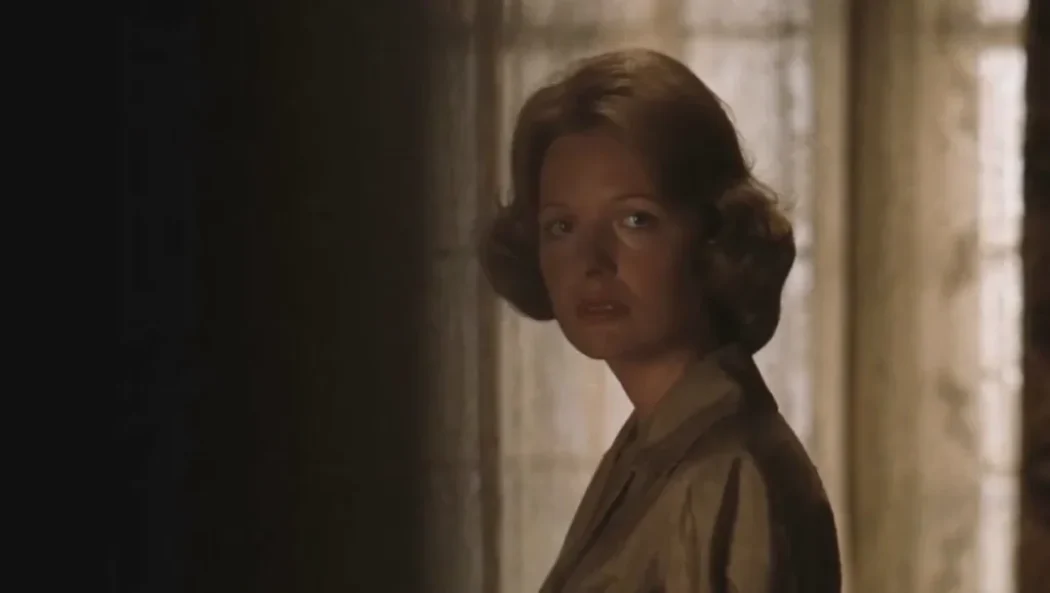
Kay watching from the doorway — realisation
Author: Aromal